AHK-Cu vs GHK-Cu: Sequence, Copper Binding and Analytical Identity
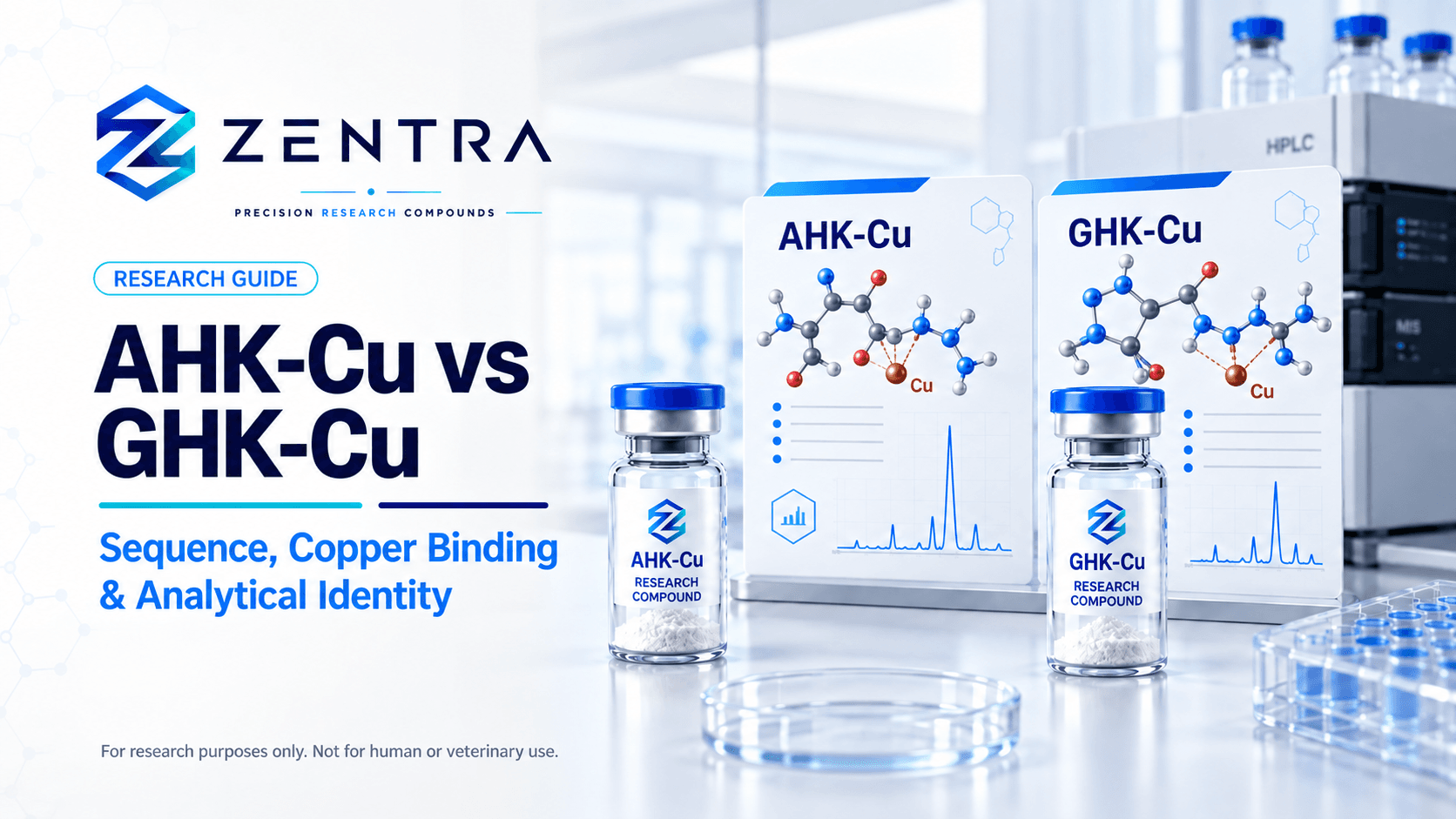
AHK-Cu and GHK-Cu are copper complexes of two different tripeptides. The similar names make them easy to confuse, but the first amino acid is different and that changes the compound’s analytical identity.
This guide focuses on nomenclature, molecular distinction and laboratory verification. It does not make cosmetic or medical claims and does not provide personal-use instructions.
What does “Cu” mean?
The “Cu” suffix indicates a copper complex. AHK and GHK are peptide abbreviations written in the standard one-letter amino-acid code:
- AHK: alanine–histidine–lysine
- GHK: glycine–histidine–lysine
Both contain histidine and lysine, but AHK begins with alanine while GHK begins with glycine. That single residue difference changes the peptide mass and means each requires its own reference data.
AHK-Cu vs GHK-Cu at a glance
| Feature | AHK-Cu | GHK-Cu |
|---|---|---|
| Peptide sequence | Ala–His–Lys | Gly–His–Lys |
| First residue | Alanine | Glycine |
| Complex | Copper-associated AHK | Copper-associated GHK |
| Identity requirement | Must match AHK-Cu reference data | Must match GHK-Cu reference data |
Why copper-complex terminology matters
A peptide name, a peptide–copper complex and a finished preparation are not automatically equivalent descriptions. Documentation should state what was analysed. Researchers should not assume that a result for the uncomplexed tripeptide proves the composition of a stated copper complex.
Colour may be a useful observation in a laboratory record, but appearance cannot establish sequence, copper content, purity or identity.
How can the two compounds be distinguished analytically?
Mass spectrometry can provide evidence that the observed molecular species is consistent with the expected peptide or complex. HPLC can describe chromatographic purity under the reported method. Because the sequences differ, the expected mass information for AHK-Cu and GHK-Cu should also differ.
Neither a blue colour nor a high HPLC percentage should be treated as a substitute for complete identity documentation. For a fuller explanation, see HPLC vs mass spectrometry.
What to check on a certificate of analysis
- The exact name: AHK-Cu or GHK-Cu
- A batch or sample identifier matching the supplied material
- The method used for purity and the method used for identity
- Numerical results rather than a generic “pass” statement
- The test date and laboratory details
Researchers can also use the ZENTRA batch-verification page to locate available batch documentation.
Research materials
ZENTRA lists separate research materials for AHK-Cu and GHK-Cu. The related GHK-Cu research guide explores that compound in more detail; this page is specifically designed to prevent confusion between the two identities.
Frequently asked questions
Is AHK-Cu another name for GHK-Cu?
No. They are related copper–tripeptide complexes with different first amino-acid residues.
Can appearance confirm copper-peptide identity?
No. Appearance alone cannot confirm sequence, mass, copper content or purity.
Does a purity percentage prove which copper peptide is present?
No. Purity testing and identity testing answer different analytical questions.
Further reading
Research-use notice: This article is educational laboratory information only. ZENTRA research compounds are not for human or veterinary use.