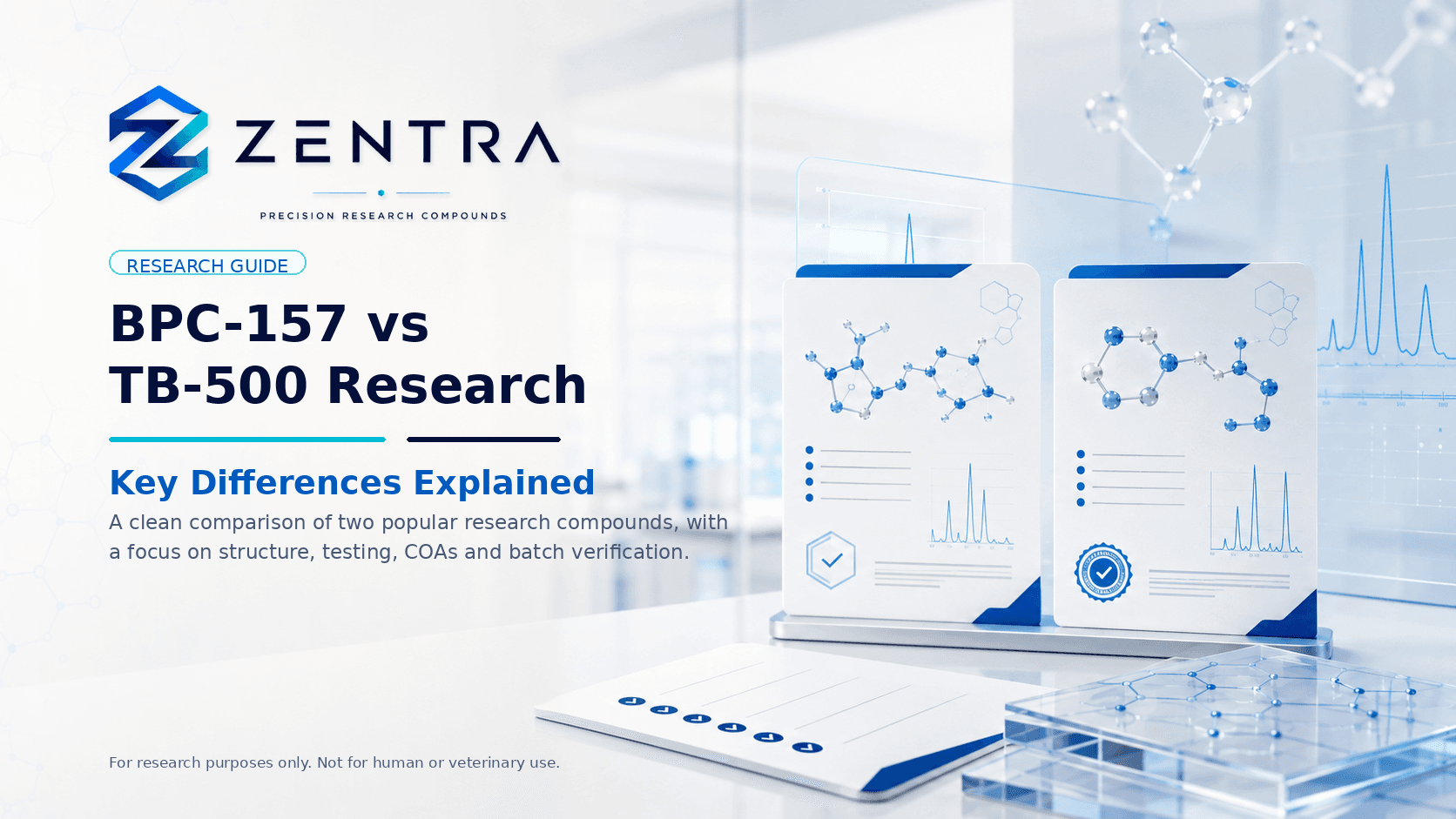
BPC-157 vs TB-500 Research: Key Differences Explained
Introduction
Within the scientific community, BPC-157 and TB-500 are two of the most frequently searched and studied research compounds. These synthetic peptides are often discussed together in academic and laboratory settings due to their overlapping areas of interest. However, it is crucial to understand that they are entirely distinct compounds with different structural profiles and mechanisms of action. This guide provides a clear, educational overview of both peptides, highlighting their key differences and explaining why researchers often study them concurrently.
What Is BPC-157?
BPC-157 (Body Protection Compound-157) is a synthetic peptide fragment consisting of 15 amino acids. It is derived from a protective protein naturally found in the gastric juice of the human stomach. In laboratory environments, BPC-157 is commonly researched in relation to tissue, gut, inflammatory, and repair pathways. Experimental models frequently investigate its potential role in angiogenesis (the formation of new blood vessels) and the upregulation of growth factor receptors. Researchers utilise BPC-157 to observe how these mechanisms might influence cellular responses to stress or controlled tissue-stress models in controlled, in vitro settings.
What Is TB-500?
TB-500 is a synthetic version of a naturally occurring peptide related to thymosin beta-4, a protein found in almost all human and animal cells. It consists of 43 amino acids and is primarily studied for its potential effects on cell migration, tissue remodelling, and recovery pathways. In research settings, TB-500 is often observed for its interaction with actin, a vital cellular protein essential for cell structure and movement. By binding to actin, TB-500 is hypothesised to influence cellular motility, which is a key component of tissue repair models in experimental research.
BPC-157 vs TB-500: Main Differences
While both peptides are central to recovery-focused research, they operate through different pathways. The table below outlines the primary distinctions between the two compounds:
| Feature | BPC-157 | TB-500 |
|---|---|---|
| Peptide Type | Synthetic fragment of gastric juice protein | Synthetic analogue related to Thymosin Beta-4 |
| Research Focus | Angiogenesis, gastrointestinal pathway research, localised repair pathways | Actin upregulation, cell migration, broader tissue remodelling |
| Structure | 15 amino acids | 43 amino acids |
| Common Research Interest | Tendon, ligament, and gastric mucosal repair models | Muscle tissue, cellular motility, and systemic recovery models |
| Why Researchers Compare Them | Often viewed as targeting specific, localised repair mechanisms | Often viewed as facilitating wider, systemic cellular migration |
Why Are They Often Researched Together?
In advanced experimental protocols, BPC-157 and TB-500 are frequently researched together because they offer complementary research angles. While BPC-157 is often discussed for its potential to influence localised repair pathways and blood vessel formation at a specific site, TB-500 is typically discussed in the context of broader tissue remodelling and cellular migration pathways across a wider area. Researchers theorise that studying these two distinct mechanisms concurrently may provide a more comprehensive understanding of complex cellular recovery and tissue regeneration models.
What Is the Wolverine Blend?
To facilitate studies that require both compounds, researchers often utilise a combined formulation. The Wolverine blend is a specific research blend containing both BPC-157 and TB-500. This pre-formulated mixture is designed for research settings where both compounds are being studied together, ensuring precise ratios and reducing the variables associated with preparing multiple separate solutions. It allows laboratories to efficiently investigate the synergistic effects of targeting both localised angiogenesis and broader cell migration pathways simultaneously.
Testing, COAs & Batch Verification
Any comparative analysis of BPC-157 and TB-500 is fundamentally meaningless if the compounds themselves are not of the verified purity and correctly identified. Rigorous testing is essential. Researchers must demand access to Third Party Tested COAs to ensure the validity of their experimental inputs. At Zentra, we prioritise absolute transparency. Every compound we supply undergoes independent testing, and researchers can utilise our Batch Verification system to instantly access the specific analytical data for their exact vial, ensuring complete confidence in the materials used for their studies.
Storage & Handling
Proper storage and handling are critical to maintaining the stability of these delicate synthetic peptides. Both BPC-157 and TB-500 are typically supplied in a lyophilised (freeze-dried) format. Prior to reconstitution, they should be stored in cold conditions, generally in a freezer or refrigerator, away from direct light and moisture. Once reconstituted with a suitable solvent, such as bacteriostatic water, the solution must be kept refrigerated and handled with strict adherence to laboratory best practices to prevent degradation and ensure accurate experimental results.
Final Thoughts
In summary, while BPC-157 and TB-500 are both highly popular research peptides focused on tissue-remodelling and cellular-response models, they possess fundamentally different research profiles. BPC-157 is primarily associated with localised tissue repair and angiogenesis, whereas TB-500 is linked to broader cellular migration and tissue remodelling. Understanding these distinct mechanisms is vital for designing accurate and effective laboratory experiments.
For multi-compound research that also includes GHK-Cu and KPV, see the fixed-composition KLOW-80 blend.
Explore Zentra’s batch-verified BPC-157, TB-500 and Wolverine research compounds, supplied for research purposes only.
For research purposes only. Not for human or veterinary use.