BPC-157 Peptide UK: Laboratory Research & Purity Guide
When assessing BPC-157 for UK laboratory research, distinguish the reference chemical identity from the evidence available for the supplied batch. A product name or headline purity figure does not establish every property of a sample.
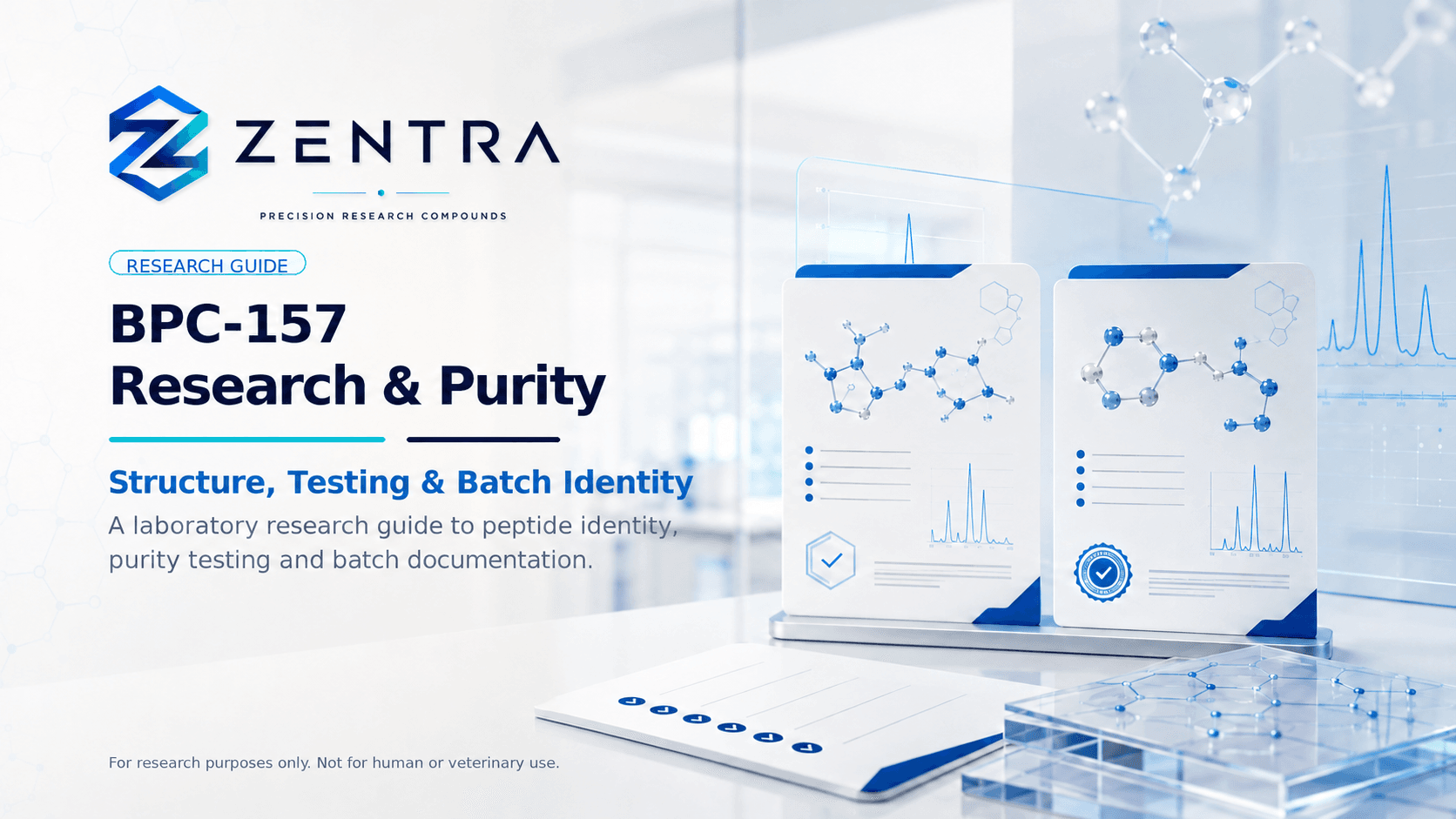
This guide focuses on identity, analytical documentation and procurement questions. It does not provide instructions for human or veterinary use. The banner is illustrative artwork, not a molecular identification result or a Certificate of Analysis.
BPC-157 reference identity
BPC-157 is described as a 15-amino-acid peptide. The PubChem record for BPC-157 (CID 9941957) lists the sequence GEPPPGKPADDAGLV, the molecular formula C62H98N16O22, and an average molecular weight of approximately 1419.5 g/mol for the reference structure.
These reference identifiers describe a chemical entry. They are not a test result for a vial, and should not be presented as proof of the identity or purity of stock held by a supplier.
Check the specified chemical form, modifications and relevant identifiers when comparing documents. A name shared between a catalogue and a report is a starting point for checking traceability, not the end of that check.
Which batch does the report cover?
Start with the material being supplied. Ask which production lot it comes from, which sample was tested and how the identifiers on the product and report connect.
A supplier may use an internal stock or batch code while a laboratory records its own sample identifier. Request the documented mapping if those codes differ. Do not assume that a report for another compound, formulation, vial size or historical lot applies to the current stock.
Our batch traceability guide explains the document trail in more detail.
What can the analytical measurements establish?
A report should state which measurements were performed, the sample identification and the relevant results. Identity assessment, chromatographic purity, net peptide content and microbiological testing are different questions; one result should not be substituted for another.
The ICH Q2(R2) guidance on analytical validation explains principles for evaluating analytical procedures. It is background on method assessment, not an approval of a particular BPC-157 product or supplier.
A matching measured mass can support an identity assessment, but does not independently establish every sequence detail or exclude every impurity. An HPLC percentage depends on the method and tested sample. Neither measurement establishes sterility or suitability for human or veterinary use.
Use our testing glossary to clarify report terminology, and ask the testing laboratory to explain ambiguous results rather than inferring them from a chart alone.
Manufacturer documentation and independent testing
Report the origin of the evidence accurately. A manufacturer COA is manufacturer documentation. Independent third-party testing should be identified separately, with its scope and sample connection explained.
At ZENTRA, testing coverage varies by product and batch. Only quote a numerical purity result where the relevant published report supports that claim for the material concerned. Do not treat a result for one batch as a guarantee covering the entire range.
Check the current BPC-157 product information and batch verification resources, or contact us before ordering if the required document is not clear.
Questions to resolve before laboratory procurement
Specification: Does the ordered material match the compound and chemical form required by the laboratory’s plan?
Traceability: Is there an explained link between the supplied lot and the sample identified in the report?
Scope: Which analytical tests were performed, and which relevant properties have not been assessed?
Applicability: Does the documentation relate to the current lot, rather than another batch or blend?
Record keeping: Can the laboratory retain the relevant report and supplier correspondence alongside its receipt record?
A standalone BPC-157 report should not be used as evidence for a BPC-157-containing blend. A mixture has its own specification, and evidence about individual components does not establish a combined effect.
Handling and research limitations
There is no universal solvent, storage temperature or shelf life that should be inferred from the BPC-157 name alone. Use the material-specific documentation, relevant safety information and the laboratory’s validated procedures.
A clear solution or a visually uniform powder is not proof of identity, purity or sterility. If a result or handling requirement is missing, request clarification instead of filling the gap with a generic internet protocol.
For wider context, read What Are Peptides? and our guide to checking peptide supplier documentation.
For research purposes only. Not for human or veterinary use.