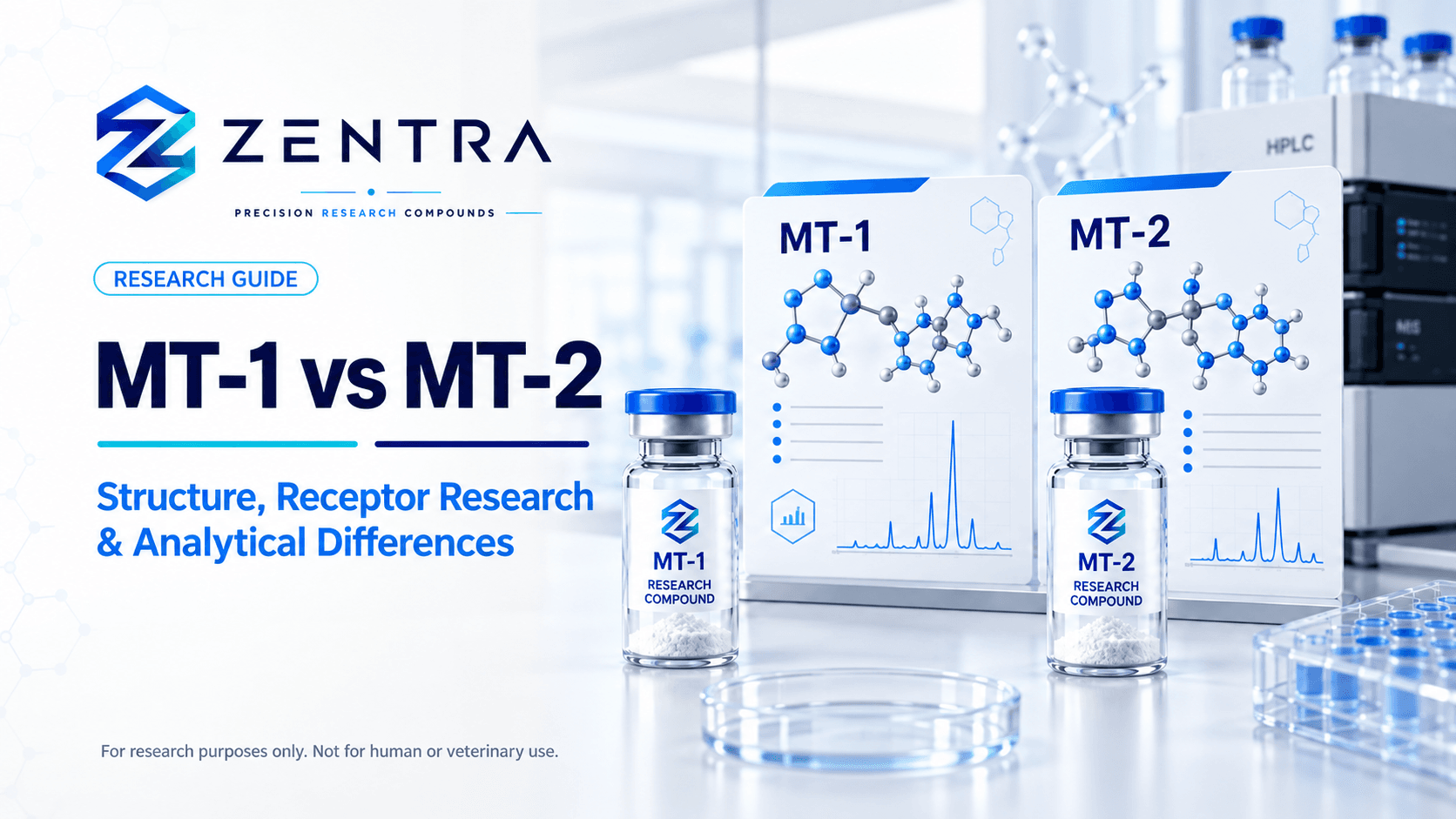
MT-1 and MT-2: Material Names and Structural Distinctions
Identify the Research Material
MT-1 and MT-2 refer to different melanocortin analogues. MT-1 is commonly described as a linear analogue, while MT-2 has a cyclic structure. Similar names do not make them equivalent materials.
Compare Like with Like
Use a precise reference specification, including sequence, terminal form and relevant cyclisation details. A certificate identifying one analogue should not be used as documentation for the other. No personal cosmetic recommendation is made in this guide.
Interpret Scientific Evidence Carefully
Separate a material specification, an analytical measurement and a biological finding. When reading research, identify the actual material, experimental model, controls and measured endpoint. A finding in one assay or model does not establish a result in another system or a personal benefit. Missing evidence should remain identified as a limitation.
Interpret the Analytical Report Within Its Scope
Review the methods and results actually reported for the identified sample. HPLC peak-area purity describes the integrated chromatographic signal under the stated method. It is not the same as peptide content by weight or the amount in an individual vial. Mass spectrometry supports an identity assessment; an intact mass match alone does not prove every aspect of sequence identity.
Identity, chromatographic purity, measured content, sterility and endotoxin testing are separate assessments. Do not infer an unreported test from another result. A representative sample does not show that every vial or fill size was independently tested.
Traceability and Documentation
Match the compound designation and batch reference with the applicable report. Check the sample identifier, analysed fill size where stated, test date, issuing laboratory and reported method. If the report’s scope or its relationship to the supplied material is unclear, request clarification.
Available documentation can be checked on the batch verification page. The presence of a report does not itself establish suitability for a particular experiment.
Storage, Safety and Evidence Limits
Storage conditions and stability periods must be supported by documentation for the particular material. Do not transfer a temperature or shelf-life statement from another compound or assume that a research-only label establishes regulatory compliance.
For non-human laboratory research only. Not for human, veterinary, clinical or personal cosmetic use.