GHK Peptides: Chemical Structure and Analytical Verification in Laboratory Research
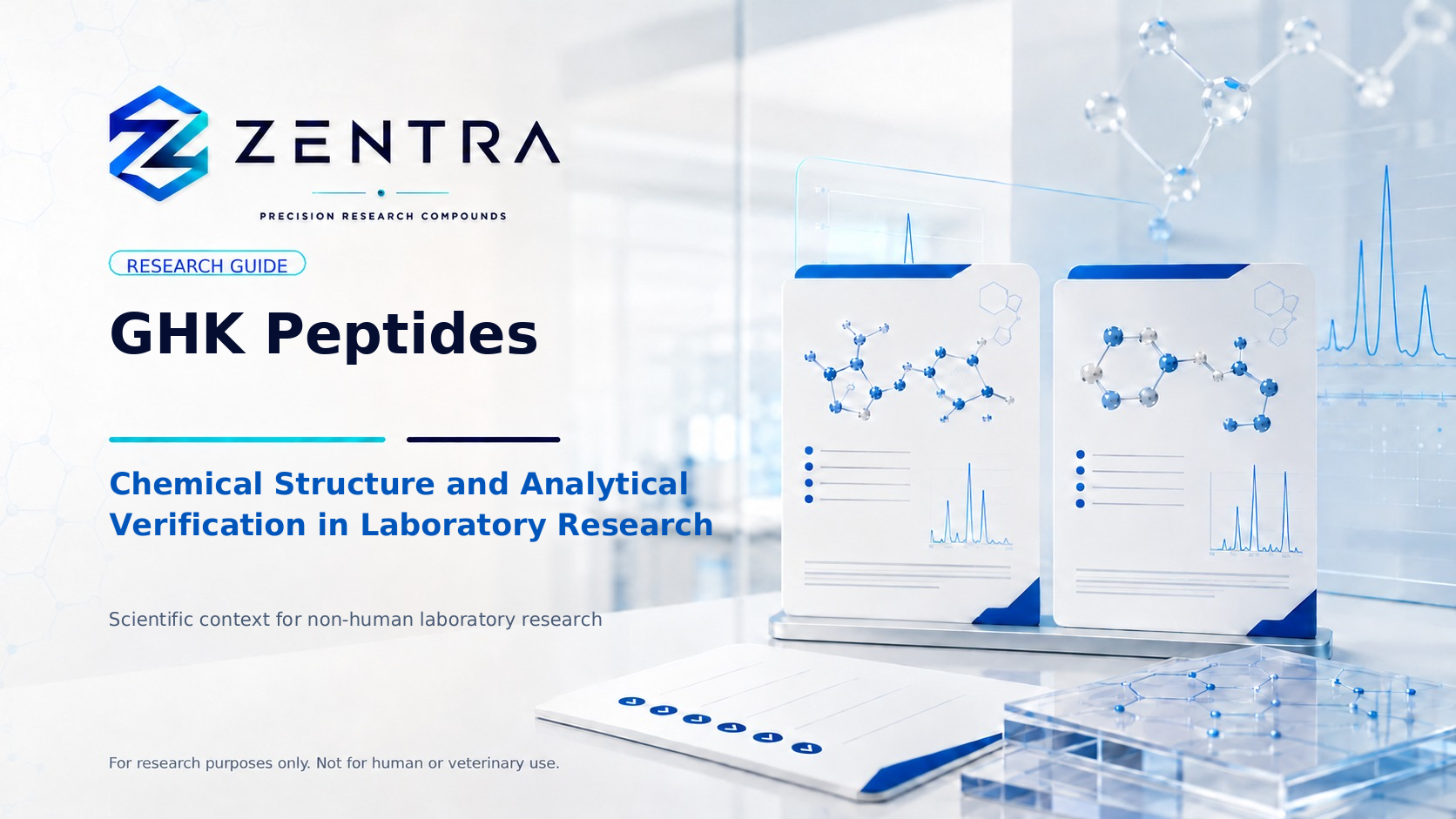
GHK peptides are tripeptide complexes composed of glycyl-L-histidyl-L-lysine, notable for their copper-binding properties and use in laboratory research. This article reviews their chemical structure, copper chelation, analytical verification, and key differences between unchelated and copper-bound forms for laboratory research purposes only.
Chemical Structure and Copper Chelation in GHK Peptides
The primary sequence of GHK consists of glycine, L-histidine, and L-lysine, creating a compact hydrophilic framework. Each amino acid residue in the sequence provides a distinct structural or functional role:
- Glycine: Located at the amino-terminal position, glycine provides conformational flexibility due to its single hydrogen side chain. Its terminal amino group serves as an electron-donating ligand during metal coordination.
- L-Histidine: Situated centrally, the histidine residue serves as the structural anchor. The unprotonated imidazole ring contains an available nitrogen lone pair that establishes a strong coordinate bond with transition metals.
- L-Lysine: Forming the carboxyl terminus, lysine features an aliphatic chain terminating in a primary amino group. This residue contributes a net positive charge in neutral solutions, facilitating electrostatic attraction to negatively charged membrane components.
Chelation occurs when the tripeptide encounters divalent copper ions in neutral aqueous buffers. The resulting complex forms a square-planar coordination geometry involving the N-terminal amine nitrogen, the deprotonated peptide amide nitrogen, the imidazole ring nitrogen of histidine, and an oxygen atom from an adjacent solvent molecule. Detailed structural fundamentals of related synthetic compounds are covered in the what are peptides guide.
Free GHK vs GHK-Cu: Key Differences in Laboratory Assays
Distinguishing between unchelated GHK and the pre-chelated GHK-Cu complex is fundamental when designing controlled laboratory protocols. Although both preparations share an identical peptide backbone, their physical appearance, spectroscopic signatures, and chemical reactivity differ substantially.
| Analytical Parameter | Unchelated GHK | GHK-Cu Coordination Complex |
|---|---|---|
| Physical Appearance | White to off-white lyophilised powder | Distinct light blue to deep blue powder |
| Aqueous Solution Colour | Clear and colourless | Vivid blue (concentration-dependent) |
| Copper Content | Negligible / undetectable | Stoichiometric 1:1 molar chelation |
| Visible Spectral Peak | No visible absorbance (UV only) | Characteristic visible peak (~600 nm) |
| Buffer Sensitivity | Stable across broader pH range | Dissociates rapidly in acidic media |
Serum-containing culture media can present a challenge when testing unchelated peptide preparations. Fetal bovine serum contains endogenous albumin and copper ions that readily coordinate with free GHK during incubation. When free peptide is added to standard serum-supplemented media, it quickly forms GHK-Cu in situ, altering experimental baselines. Researchers studying the unchelated form may utilise chemically defined, serum-free media or introduce specific metal-chelating agents to isolate native tripeptide activity. These considerations pertain to chemical and analytical variables, not biological outcomes.
Modified variants like AHK-Cu replace glycine with alanine, altering steric hindrance around the coordination pocket while retaining copper affinity for comparative structural models.
Analytical Verification: High-Performance Liquid Chromatography and Mass Spectrometry
Confirming compound purity and elemental identity is important for reproducible laboratory research. Analytical validation identifies incomplete synthesis sequences, leftover trifluoroacetic acid salts, and non-stoichiometric metal chelation.
Reversed-Phase High-Performance Liquid Chromatography (RP-HPLC) serves as a standard for assessing chemical purity. The method employs an analytical C18 silica column using an aqueous-organic solvent gradient containing volatile acid modifiers. High-purity preparations produce a sharp, symmetrical peak with minimal baseline drift, while incomplete synthesis products or truncated sequences appear as distinct secondary peaks. Additional criteria for reviewing analytical traces are detailed in the guide on how to read a certificate of analysis (COA).
Mass spectrometry complements chromatography by verifying exact molecular mass and coordination states:
- Unchelated Tripeptide: Electrospray ionisation mass spectrometry of free GHK displays a primary protonated molecular ion peak corresponding to the exact calculated mass of the tripeptide backbone.
- Copper Complex: Mass spectra of GHK-Cu reveal an upward mass shift corresponding to copper coordination with the loss of coordinating amide protons, accompanied by the distinct isotopic distribution signature of natural copper isotopes.
Laboratory managers establishing standard procurement practices can consult the UK peptide suppliers verification guide for validation protocols.
Frequently Asked Questions
What are the main chemical and analytical handling challenges of copper peptides?
Handling challenges include pH sensitivity, spontaneous copper dissociation in acidic environments, and interference from background serum proteins in analytical assays. If buffers drop below neutral pH, the tripeptide may lose its bound copper ion, altering analytical results and generating free ionic copper. Introducing unchelated GHK into serum-containing media can result in uncontrolled chelation of ambient trace metals, affecting chemical analysis.
How does analytical testing confirm batch quality for GHK peptides?
Quality assessment requires complementary chromatography and spectrometry techniques. Reversed-phase liquid chromatography quantifies purity by separating the main analyte from deletion sequences or synthesis byproducts. Mass spectrometry verifies the exact molecular weight of the tripeptide and confirms stoichiometric copper coordination through distinctive isotopic distribution patterns. These methods are used for laboratory research verification only.
How do pricing and material grades vary for laboratory research copper peptides?
Material pricing reflects the synthesis methodology, purification steps, and extent of analytical verification provided by the supplier. High-grade laboratory research compounds requiring multi-stage preparative chromatography, rigorous salt exchanges, and independent mass verification require greater manufacturing resources than unpurified crude materials. Researchers should evaluate documented analytical reports rather than raw cost alone when selecting materials for laboratory research.
For non-human laboratory research only. Not for human, veterinary, clinical or personal cosmetic use.