How to Read a Peptide Certificate of Analysis (COA)
Introduction to Peptide Quality Assurance
In the realm of scientific research, the integrity of your experimental data is directly tied to the quality of the compounds you utilise. When sourcing UK peptides for laboratory studies, researchers must demand rigorous quality control documentation. The most critical document in this process is the Certificate of Analysis (COA). A COA serves as the definitive proof of a compound’s identity, purity, and overall quality.
Understanding how to properly read and interpret a peptide COA is an essential skill for any principal investigator or laboratory technician. This guide will break down the key sections of a standard COA, explain how to interpret the analytical data, and highlight why batch-specific documentation is non-negotiable for reliable research outcomes.
What is a Certificate of Analysis (COA)?
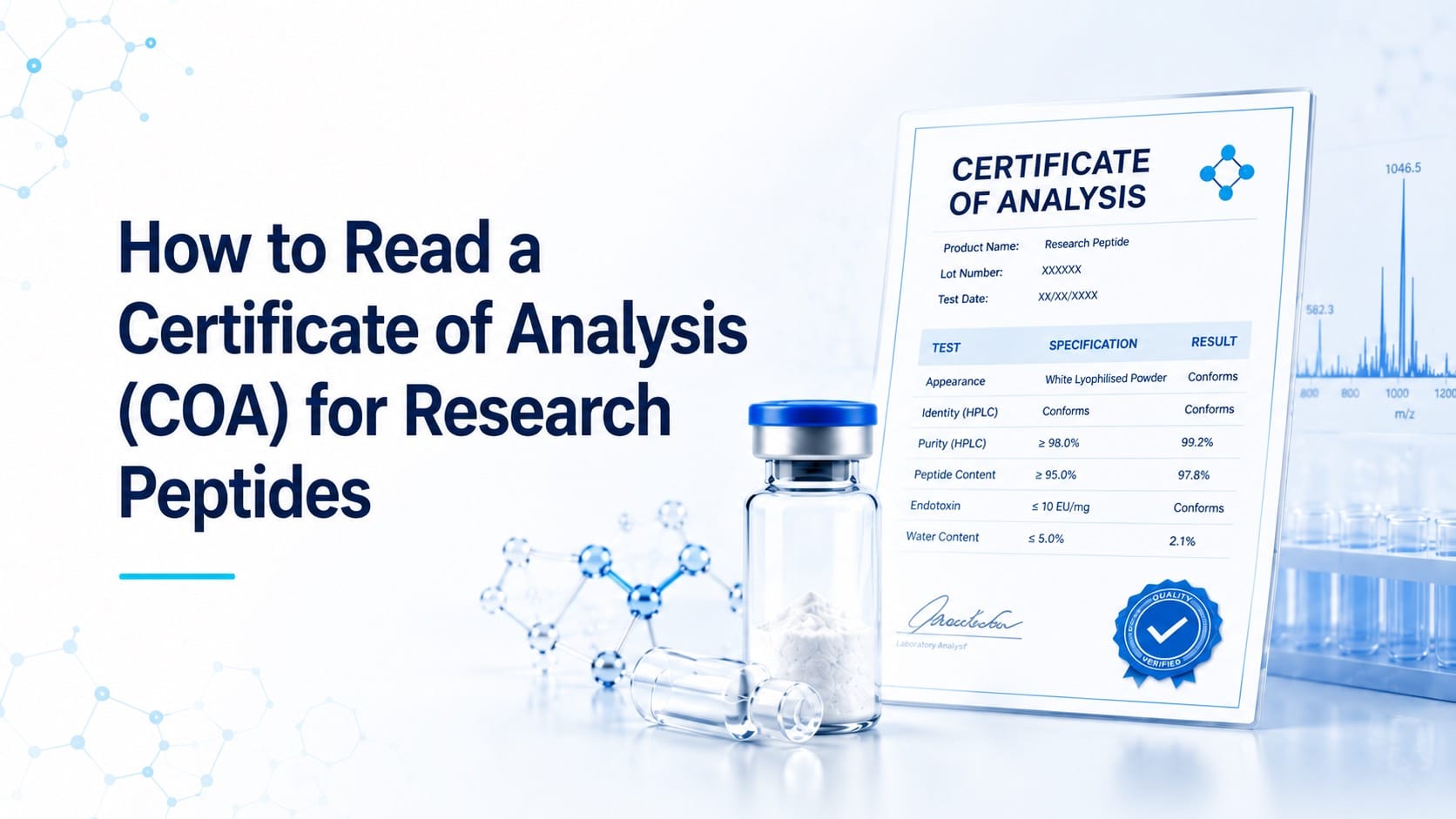
A Certificate of Analysis is a formal laboratory document issued by a quality assurance department or an independent testing facility. It details the specific testing parameters, specifications, and actual results obtained for a particular batch of a chemical compound. For research peptides, the COA confirms that the synthesised material matches the requested amino acid sequence and meets strict purity thresholds.
Without a valid, batch-specific COA, researchers risk introducing unknown variables into their assays, potentially invalidating months of hard work. This is why sourcing third party tested peptides is the gold standard in modern laboratory practice.
Key Sections of a Peptide COA
1. Compound Identity and Batch Information
The header of the COA should clearly state the name of the peptide, its molecular formula, and the specific batch or lot number. This batch number is crucial for traceability. If you are conducting a longitudinal study, ensuring consistency across different batches—or knowing exactly which batch was used for which experiment—is vital for reproducibility.
2. Appearance and Physical Characteristics
This section describes the physical state of the compound upon inspection. High-quality peptides are typically supplied as a lyophilised (freeze-dried) powder. The appearance should be noted as a white or off-white solid. Any discoloration or unexpected physical state could indicate degradation or contamination during the manufacturing process.
3. Molecular Weight (Mass Spectrometry)
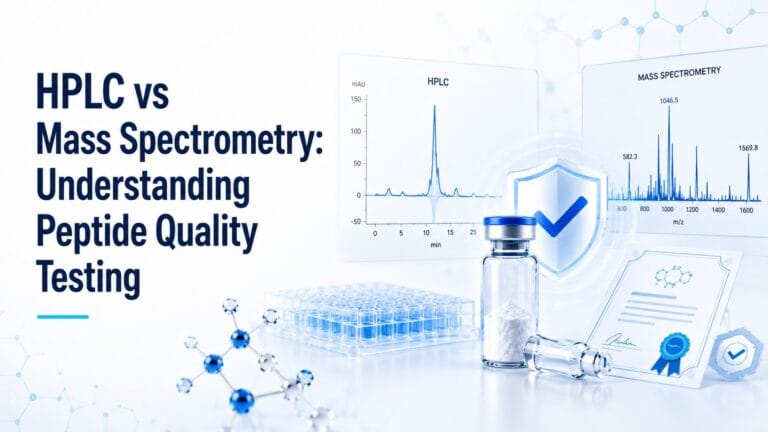
The COA will list both the theoretical molecular weight of the peptide and the observed molecular weight determined via Mass Spectrometry (MS). The observed mass must closely match the theoretical mass (usually within ±1 Dalton). This confirms the structural identity of the peptide—verifying that the correct amino acids were assembled in the correct sequence.
4. Purity Percentage (HPLC Analysis)
Perhaps the most scrutinised metric on a COA is the purity percentage, determined by High-Performance Liquid Chromatography (HPLC). For stringent laboratory applications, a purity of >99% is often required. The HPLC section will detail the chromatographic conditions and report the relative area of the primary peak compared to any impurities or truncated sequences.
How to Interpret HPLC Results
When reviewing the HPLC chromatogram attached to or summarised in the COA, researchers should look for a single, sharp, and symmetrical primary peak. This peak represents the target peptide. Any smaller secondary peaks indicate impurities, such as incomplete sequences, deletion errors, or oxidation byproducts.
A high-quality peptide purity testing UK report will clearly define the integration of these peaks. If the main peak accounts for 99.2% of the total area, the peptide purity is 99.2%. It is important to ensure that the baseline of the chromatogram is stable and that the resolution is sufficient to distinguish the main product from closely related impurities.
Why Batch-Specific COAs Matter
A generic or sample COA is insufficient for rigorous scientific research. Synthesis of complex peptides is a delicate process, and variability can occur between production runs. A batch-specific COA guarantees that the exact vial you are reconstituting in your laboratory has been tested and verified.
Reputable suppliers of UK peptides will always provide documentation that matches the lot number on the vial. At ZENTRA, every batch COA is available on our batch verification page. This transparency ensures that you are working with the exact specifications required for your sensitive assays, from cellular binding studies to in vitro receptor activation models.
Why This Matters for Your Research
At ZENTRA Peptides, we understand that precision is the foundation of scientific discovery. That is why every batch of our precision research compounds undergoes rigorous analytical testing. By providing transparent, batch-specific COAs, we empower researchers to proceed with absolute confidence in their materials. When you require third party tested compounds that meet the highest standards of purity and identity, ZENTRA Peptides delivers uncompromising quality.
Disclaimer: All compounds available from ZENTRA Peptides are intended strictly for in vitro research and laboratory use only. They are not intended for human consumption, therapeutic application, or any form of bodily introduction. Researchers must comply with all applicable local regulations.