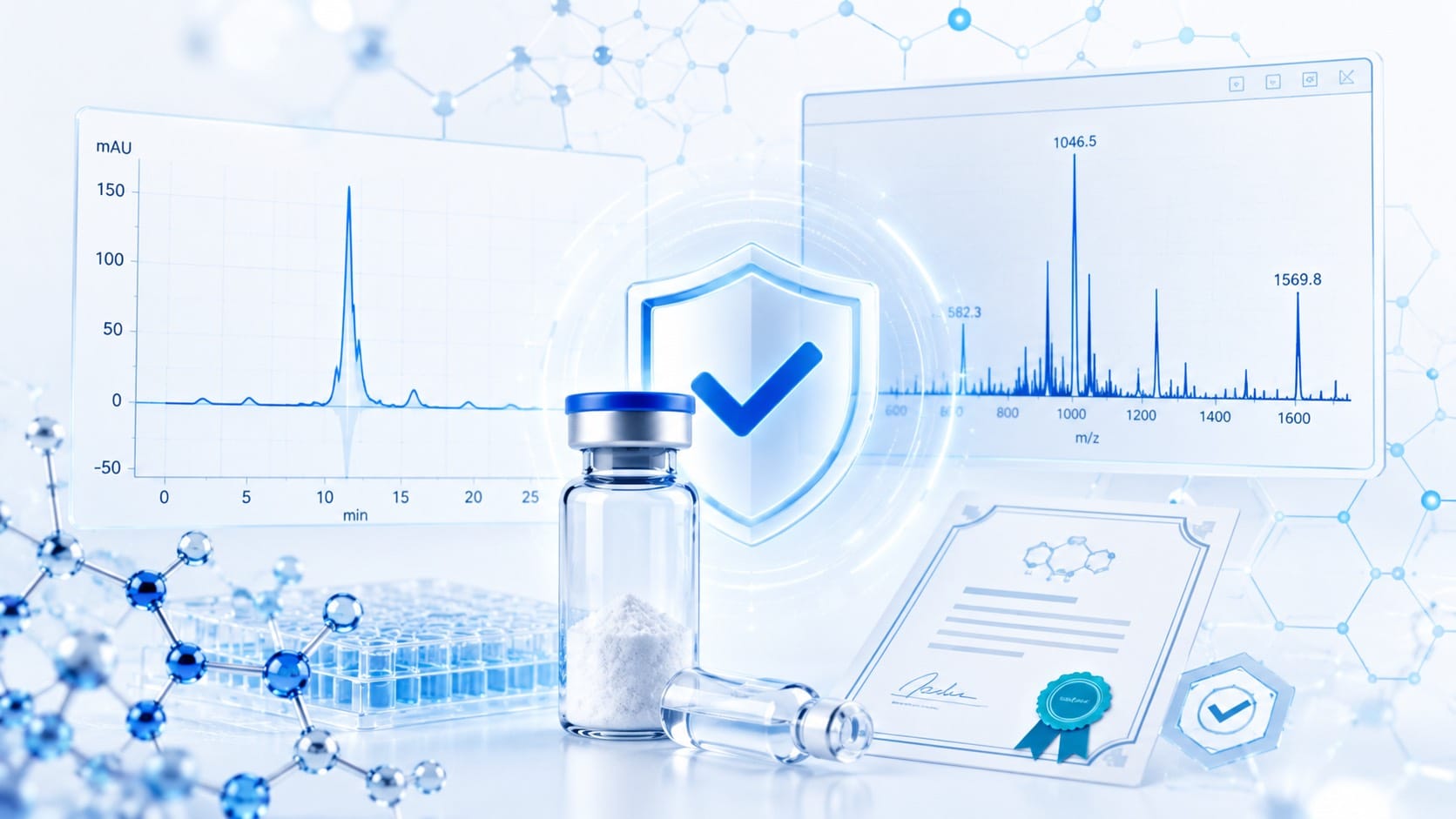
Peptide Purity Testing: What “Above 99%” Means
Introduction
In the exacting field of laboratory research, the quality of reagents directly dictates the validity of experimental results. When working with synthetic peptides, purity is not merely a preference; it is a fundamental requirement. Even minute levels of impurities can introduce confounding variables, leading to skewed data, irreproducible results, and wasted resources.
This article explores the critical importance of peptide purity testing, the analytical methods used to determine it, and why the standard of “exceeds 99%” purity is essential for rigorous scientific inquiry. As a leading provider among UK peptide companies, ZENTRA Peptides is committed to transparency and quality, ensuring all our products are rigorously third-party tested. Browse our full catalogue.
Disclaimer: All products provided by ZENTRA Peptides are strictly for research purposes only and are not intended for human consumption or therapeutic use.
Why Purity Matters in Research
Synthetic peptides are produced through complex chemical processes, typically Solid-Phase Peptide Synthesis (SPPS). During synthesis, incomplete reactions, side reactions, or cleavage processes can result in the formation of impurities. These impurities usually take the form of truncated sequences (missing amino acids), deletion sequences, or chemically modified peptides (e.g., oxidation or deamidation).
The presence of these impurities can severely impact research outcomes in several ways:
- Off-Target Effects: Impurity peptides may bind to unintended receptors or enzymes, producing biological responses that mask or mimic the effects of the target peptide.
- Toxicity: Certain synthesis by-products can be toxic to cell cultures or animal models, leading to cell death or physiological distress that is unrelated to the peptide being studied.
- Concentration Error: If analytical purity or net-content assumptions are incorrect, molar-concentration assumptions can be wrong, compromising concentration-response analysis.
- Immunogenicity: In in vivo studies, impurities can trigger unwanted immune responses, further complicating data interpretation.
Analytical Methods for Purity Testing
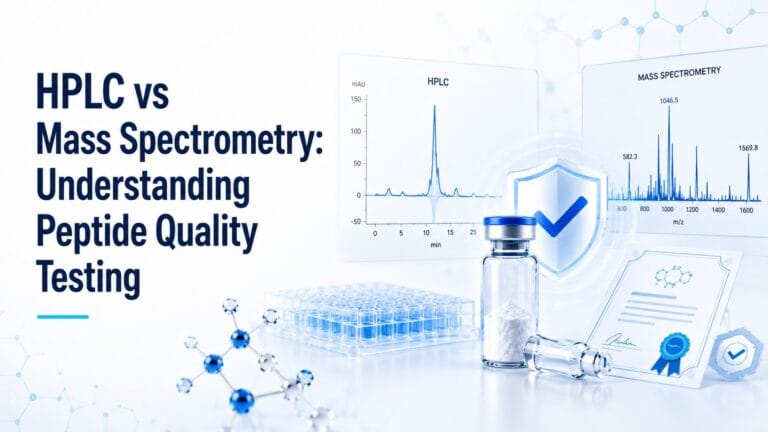
To ensure the integrity of a peptide, rigorous analytical testing is required. The two primary techniques used in the industry are High-Performance Liquid Chromatography (HPLC) and Mass Spectrometry (MS).
High-Performance Liquid Chromatography (HPLC)
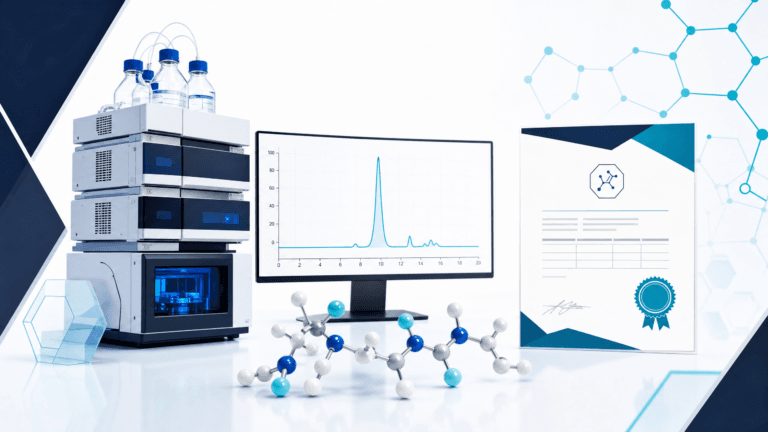
HPLC is the standard method for determining the purity percentage of a peptide sample. The technique separates the components of a mixture based on their chemical interactions with a stationary phase (the column) and a mobile phase (the solvent).
As the sample passes through the column, the target peptide and any impurities will elute (exit the column) at different times, creating distinct peaks on a chromatogram. The area under the main peak, relative to the total area of all peaks, provides the purity percentage.
Mass Spectrometry (MS)
While HPLC determines the amount of impurities, Mass Spectrometry confirms the identity of the target peptide. MS measures the mass-to-charge ratio of ions, allowing analysts to verify that the primary component of the sample matches the exact theoretical molecular weight of the desired peptide sequence.
Together, HPLC and MS provide a comprehensive profile of a peptide’s quality, confirming both its purity and its identity.
What “Exceeds 99%” Means
In the context of peptide synthesis, achieving a purity that exceeds 99% is a marker of exceptional manufacturing quality. It normally means the principal peak accounts for more than 99% of the integrated chromatographic signal under the reported method. It does not by itself measure net fill weight, sterility, endotoxin, residual solvents, counter-ions or water content.
Acceptance criteria should be defined by the study and a fit-for-purpose analytical method; no single purity percentage answers every quality question.
What HPLC and MS Do Not Prove
HPLC area percentage is method-dependent and is not the same as peptide content by weight. MS can support molecular identity, but a matching mass does not establish purity, sterility, endotoxin status, residual solvents, counter-ion content or fill quantity. Those require separate, appropriately validated measurements.
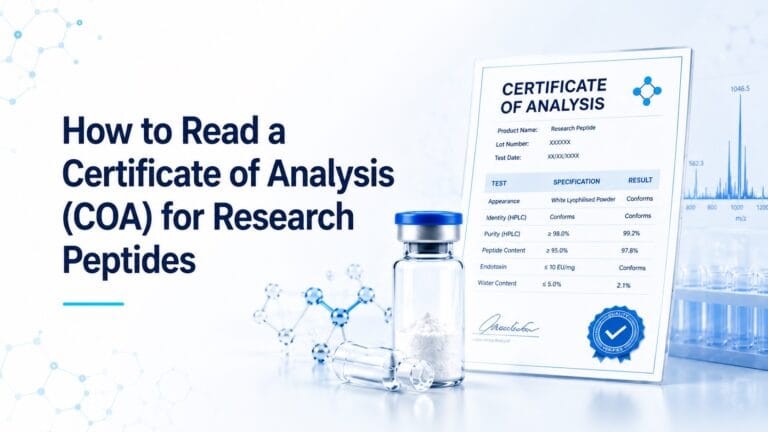
A useful COA should identify the batch, laboratory, test date, method and reported result so the evidence can be interpreted in context.
Verifying Supplier Claims: The Role of Third-Party Testing
Many suppliers claim high purity, but these claims must be verifiable. In-house testing, while necessary for quality control during manufacturing, can be subject to bias. This is why independent, third-party testing is crucial.
Why Third-Party Testing Matters
When searching for third-party tested peptides UK, researchers should look for companies that provide Certificates of Analysis (COAs) from independent analytical laboratories. These documents provide objective, unbiased verification of the HPLC and MS results.
A legitimate COA should include:
- The specific batch or lot number of the peptide.
- The date of analysis.
- Clear HPLC chromatograms showing a single, sharp main peak.
- MS spectra confirming the correct molecular weight.
By relying on third-party verification, researchers can confidently source reagents that meet the stringent demands of their protocols.
Conclusion
The integrity of scientific research rests on the quality of the materials used. Peptide impurities can compromise data, waste valuable time, and lead to erroneous conclusions. Understanding the methods used to test purity and demanding a standard that exceeds 99% is essential for any laboratory working with synthetic compounds. ZENTRA Peptides is dedicated to supporting the scientific community by providing meticulously synthesised, third-party tested peptides, supporting research with documented batch-specific analytical evidence. View our results on the batch verification page.
For research purposes only. Not for human consumption.