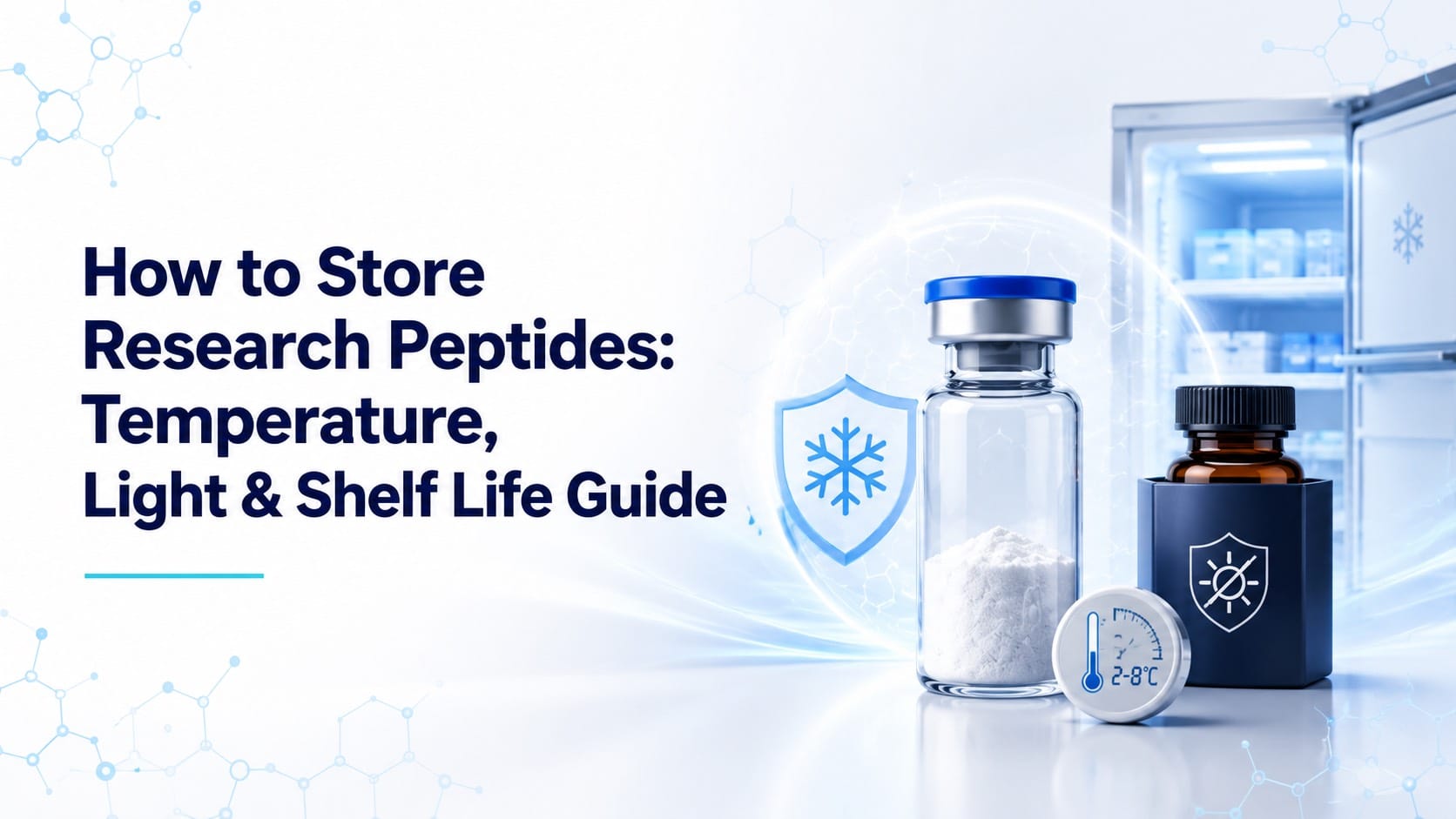
Peptide Storage Temperature: Research Handling & Shelf Life Guide
Peptide Storage Temperature: Quick Answer
Short answer: There is no single storage temperature or shelf life that applies to every peptide. Follow the supplier documentation, batch-specific stability information and your validated laboratory SOP. Lyophilised materials are generally kept sealed, dry, dark and cold; prepared solutions often require refrigeration, but the allowable temperature, diluent and hold time are specific to the compound, formulation and research method.
This comprehensive guide details the best practices for storing research peptides, covering optimal temperature ranges, the effects of light and moisture, the critical differences between reconstituted and lyophilised storage conditions, realistic shelf life expectations, and how to identify early signs of compound degradation. All information provided is for research purposes only.
Why Peptide Storage Matters for Research Integrity
Peptides are chains of amino acids linked by peptide bonds. These bonds, while stable under ideal conditions, are susceptible to hydrolysis (breakdown by water), oxidation, and thermal degradation. Even minor deviations from recommended storage conditions can initiate a cascade of chemical changes that alter the peptide’s three-dimensional conformation, reduce its biological activity, and compromise the accuracy of any downstream assay or experiment.
For researchers working with compounds from ZENTRA Peptides, where purity exceeds 99% as verified by independent third-party HPLC analysis, proper storage is essential to preserve that high-purity baseline throughout the duration of the study. A compound that arrives in pristine condition can degrade rapidly if not handled correctly from the moment it is received.
Optimal Temperature Ranges for Peptide Storage
Temperature is the single most important variable in peptide preservation. The appropriate storage temperature depends on whether the peptide is in its lyophilised (freeze-dried) powder form or has been reconstituted into a liquid solution.
Storing Lyophilised Peptides
Lyophilisation removes the vast majority of water from a peptide sample, dramatically slowing the hydrolytic and oxidative processes that cause degradation. This makes lyophilised peptides considerably more stable than their reconstituted counterparts, but they are by no means indestructible.
Many lyophilised research materials are supplied with refrigerated or frozen storage instructions, commonly within ranges such as 2°C to 8°C, -20°C or -80°C. These temperatures are not interchangeable and do not create a universal shelf life. Use the product label, supplier documentation and compound-specific stability data to select the correct condition for each batch. Research compounds such as BPC-157, TB-500 and GHK-Cu should therefore be handled according to their individual documentation rather than one blanket timetable.
Storing Reconstituted Peptides
Once a lyophilised peptide is prepared in solution, hydrolysis, oxidation, aggregation and microbial contamination can become more relevant. Refrigerated storage between 2°C and 8°C is common for many prepared research solutions, but it is not universally correct. Diluent choice—including whether bacteriostatic water is compatible—temperature and hold time must be supported by a validated method or compound-specific documentation.
Unvalidated freezing and repeated freeze-thaw cycles may contribute to aggregation, precipitation or loss of activity in some prepared peptide solutions. Do not freeze a solution unless the method or stability data supports it. Where frozen storage is validated, laboratories may use suitable aliquots to reduce repeated temperature cycling.
Light Sensitivity and Photodegradation
Ultraviolet (UV) radiation is a potent driver of peptide degradation. Aromatic amino acids — particularly tryptophan, tyrosine, and phenylalanine — are highly susceptible to UV-induced oxidation, which can alter the peptide’s structure and reduce its activity. Even indirect exposure to ambient laboratory lighting can, over time, contribute to measurable degradation in sensitive compounds.
To mitigate photodegradation, all peptide vials should be stored in a dark environment. Amber-coloured or opaque vials provide a physical barrier against light and are the preferred storage vessel for light-sensitive compounds. When working with peptides at the bench, minimise the time vials are exposed to direct light and return them to their dark storage environment promptly. ZENTRA’s sterile glass vials are suitable for this purpose, and a dedicated Peptide Storage Case provides an organised, light-controlled environment for managing multiple compounds simultaneously.
Moisture and Humidity Control
Moisture is perhaps the most insidious threat to lyophilised peptides. Even trace amounts of water can initiate hydrolysis and promote bacterial growth. A common mistake made in laboratory settings is opening a cold vial directly from the freezer. When a vial at -20°C is exposed to ambient air, the temperature differential causes atmospheric moisture to condense on and inside the vial, potentially contaminating the lyophilised powder.
The correct procedure is to allow the sealed vial to equilibrate to room temperature before opening it. This typically takes 15 to 30 minutes. Only once the vial has reached ambient temperature should the seal be broken. For peptides stored in environments with high ambient humidity, the use of a desiccant within the storage container is an additional protective measure worth considering.
Lyophilised vs. Reconstituted Storage: A Comparison
| Parameter | Lyophilised (Powder) | Reconstituted (Solution) |
|---|---|---|
| Optimal Temperature | Label- or protocol-defined; refrigerated or frozen depending on the material | Label- or protocol-defined; often refrigerated when stability data supports it |
| Typical Shelf Life | Compound- and batch-specific; use supplied stability data | Compound-, diluent- and method-specific |
| Freeze-Thaw Stability | Keep sealed and avoid unnecessary temperature cycling | Avoid unless validated; aliquot when appropriate |
| Moisture Sensitivity | High; keep sealed and dry | Already in solution; bacterial growth risk |
| Light Sensitivity | Moderate to high | High; store in amber or opaque vials |
Shelf Life Expectations by Compound Type
Shelf life cannot be inferred reliably from peptide length or molecular weight alone. Sequence, oxidation-prone residues, salt or counter-ion, residual moisture, formulation, container closure, oxygen exposure and temperature history can all influence stability.
A vial that looks unchanged may still have lost purity or activity. Use manufacturer or batch stability data, a validated laboratory SOP and, for critical studies, appropriate analytical confirmation rather than assuming a universal 28-day limit.
Identifying Signs of Peptide Degradation
Visual inspection, while not a substitute for analytical testing such as HPLC, can provide useful preliminary indicators of peptide degradation.
In its lyophilised form, a high-quality peptide should appear as a uniform white or off-white powder or compact puck. Warning signs include discoloration (yellowing or browning), a sticky or hygroscopic texture indicating moisture absorption, or a collapsed or sunken appearance within the vial. Any of these signs suggest the compound’s integrity may have been compromised and it should be tested before use in critical experiments.
In its reconstituted form, the solution should be completely clear and free of any particulate matter. Cloudiness, turbidity, or the presence of visible particles (precipitates) are strong indicators that the peptide has degraded, aggregated, or crashed out of solution. A discoloured solution — particularly one that has turned yellow or brown — should be considered compromised. Any vial showing these signs should be discarded and not used in research applications, as results obtained from degraded compounds cannot be considered reliable or reproducible.
Practical Storage Recommendations for Researchers
To summarise best practice: review the label, batch documentation and laboratory SOP; keep lyophilised material sealed, dry and protected from light; minimise unnecessary temperature excursions and freeze-thaw cycles; select a diluent only when compatibility is supported by the research method; and record the preparation date, concentration and storage conditions. Bacteriostatic water is appropriate only where the method permits a solution containing 0.9% benzyl alcohol.
Researchers working with multiple compounds simultaneously will benefit from ZENTRA’s Peptide Storage Case, which provides a dedicated, organised environment for maintaining research compounds in optimal condition. Browse the full range of ZENTRA research compounds to find the peptides relevant to your current study.
Organising Research Vials
A peptide storage case can help organise labelled research vials and protect them from physical knocks and direct light. It does not provide refrigeration or replace the storage conditions specified for each compound.
Disclaimer
This article is for informational and research purposes only. ZENTRA Peptides does not condone or encourage the use of peptides for human consumption. All compounds are sold strictly for legitimate research purposes. Consult relevant regulations in your jurisdiction.