Peptide Reconstitution for Laboratory Research
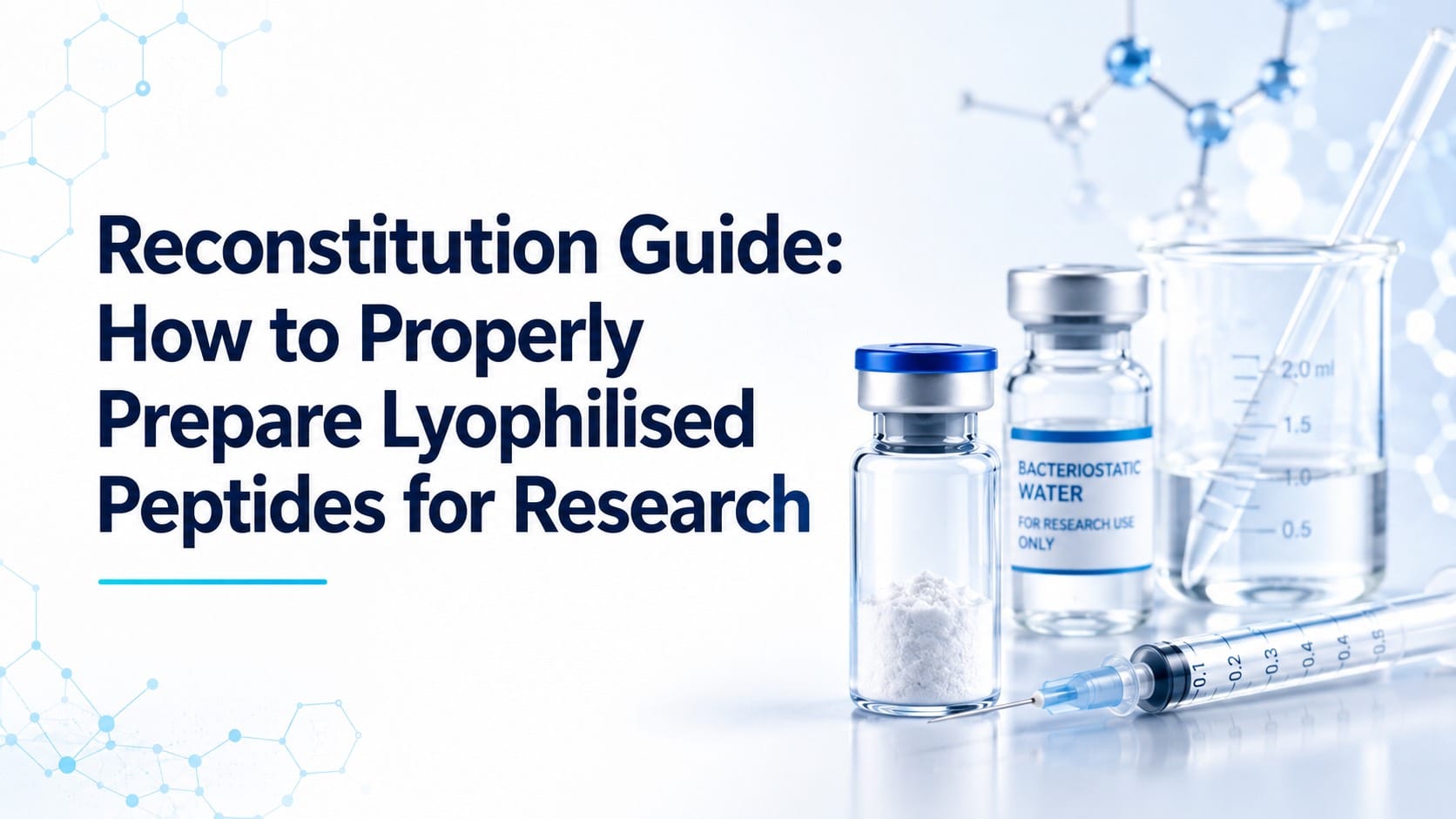
Lyophilised peptides are supplied as dry material because removing water can improve stability during storage and transport. Converting that material into a solution is a method-dependent laboratory operation: solvent choice, target concentration, container, temperature, analytical purpose and the individual peptide sequence all matter.
n
This guide explains the scientific decisions and calculations behind laboratory reconstitution. It is not a universal preparation recipe and does not provide human or veterinary use instructions.
n
Define the Intended Analytical Purpose
n
Before any preparation is made, the protocol should state what the solution will be used to measure, the required concentration range, the analytical technique, the controls and the acceptance criteria. A preparation suitable for an HPLC system-suitability check may not be suitable for a cell-based assay or a binding study.
n
Review the compound identity, batch-specific COA, expected molecular mass, reported purity, formulation information and available solubility data. HPLC area purity and MS identity are useful analytical signals, but they do not by themselves establish solvent compatibility, sterility, endotoxin status or solution stability.
n
Diluent and Container Compatibility
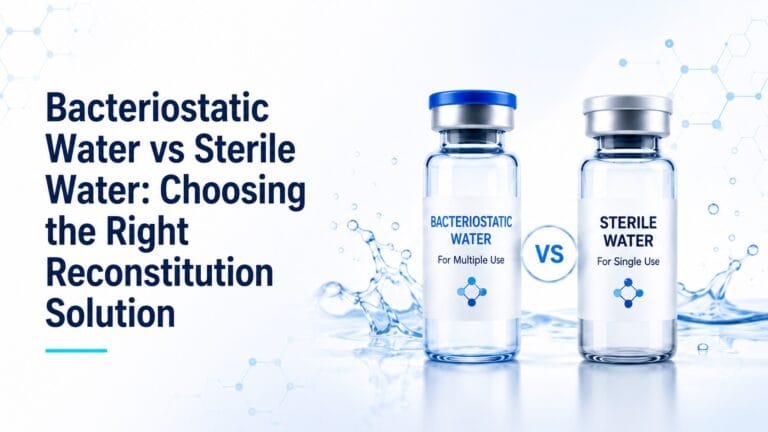
For a comparison of two commonly discussed laboratory diluents, read acetic acid water vs bacteriostatic water. The guide explains pH and compatibility considerations; neither diluent is a universal choice for every research compound.
n
No single diluent is appropriate for every peptide. Water, bacteriostatic water, buffered solutions and specialist co-solvent systems have different chemical and microbiological characteristics. Selection should follow the published experimental method, supplier documentation and the laboratory’s approved SOP.
n
Container material and surface adsorption also matter, particularly at low concentrations. The protocol should specify the vessel, closure, mixing conditions and maximum hold time. Where recovery is critical, suitability should be demonstrated with controls rather than assumed.
n
Concentration and Aliquot Calculations
n
The core arithmetic is straightforward:
n
- n
- Concentration (mg/ml) = nominal mass (mg) ÷ total solution volume (ml)
- Aliquot volume (ml) = target aliquot mass (mg) ÷ concentration (mg/ml)
- Microlitres (µl) = millilitres × 1,000
n
n
n
n
For example, a neutral model containing 10mg in a total volume of 2ml has a nominal concentration of 5mg/ml. A 0.5mg analytical aliquot would therefore occupy 0.1ml, or 100µl. This is an arithmetic example only, not a recommended protocol.
n
Verify the arithmetic independently and record every input, unit and conversion.
n
Laboratory Handling Principles
n
- n
- Work only under an approved SOP with trained personnel and suitable protective equipment.
- Use calibrated laboratory equipment with a verified range and resolution appropriate to the volume.
- Minimise unnecessary agitation, heat, light exposure and repeated temperature cycling where the compound documentation identifies those risks.
- Label the preparation with compound identity, batch code, nominal concentration, diluent, date, operator and defined storage condition.
- Apply predefined visual and analytical acceptance criteria. Unexpected precipitation, colour, turbidity or recovery should be investigated.
n
n
n
n
n
n
Stability Is Compound-Specific
n
There is no defensible universal shelf life for every peptide in every solution. Sequence, pH, buffer, concentration, oxygen, light, temperature, container and freeze-thaw history can all affect stability. Use product-specific evidence and the study protocol rather than a blanket number of days.
n
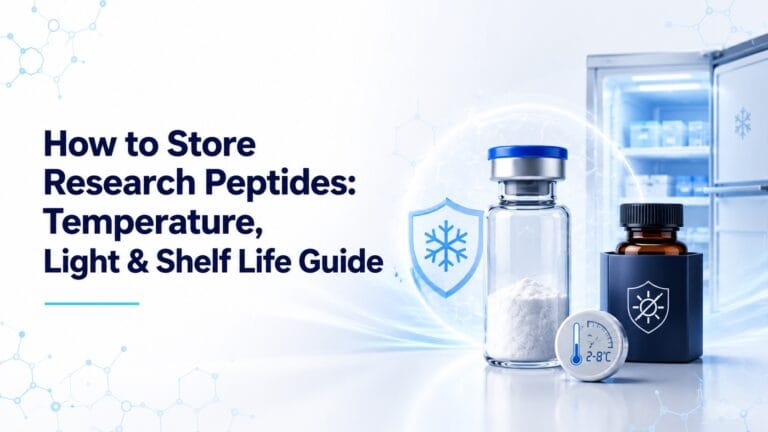
For general context, see the research peptide storage guide. The batch record and COA should also be reviewed before material is used.
n
Quality Controls and Documentation
n
Appropriate controls may include a solvent blank, reference material, replicate preparations, recovery checks and system-suitability tests. The selected analytical procedure should be fit for its intended purpose; ICH Q2(R2) and Q14 provide useful principles for analytical validation and procedure development.
n
Good records should capture the calculation, source documents, equipment identifiers, preparation history, deviations and final disposition. That is what makes a laboratory preparation reproducible and auditable.
n
Common Errors to Avoid
n
- n
- Assuming every compound uses the same solvent, concentration or storage window.
- Confusing chromatographic area purity with net peptide content or sterility.
- Mixing mg, mcg, ml and µl without a documented unit check.
- Using equipment outside its calibrated working range.
- Omitting blanks, single-compound controls or predefined acceptance criteria.
- Failing to record the batch code and preparation history.
n
n
n
n
n
n
n
For research use only. Not for human or veterinary use.