Sterile Water vs Bacteriostatic Water in Peptide Research
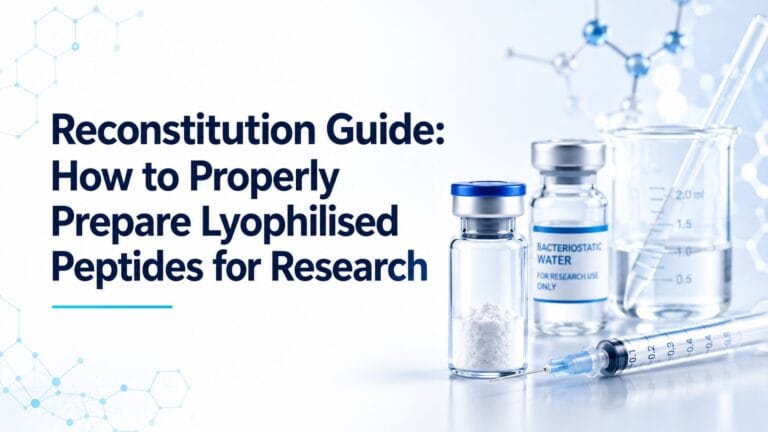
Selecting a diluent is part of experimental design, not a one-size-fits-all step. The correct choice depends on the peptide sequence, formulation, intended analytical method, target concentration, container, stability requirements and the laboratory’s validated procedure.
n
This guide compares sterile water, bacteriostatic water and buffered systems in a laboratory context. It does not recommend a personal-use preparation method.
n
What a Diluent Must Do
n
A suitable diluent must support the intended concentration without unacceptable precipitation, adsorption, degradation or interference with the analytical method. Microbiological requirements and hold time must also be defined by the protocol.
n
Solubility should be verified from compound-specific evidence. A peptide’s net charge, hydrophobicity and sequence can change its behaviour, so a solvent that works for one material may be unsuitable for another.
n
Sterile Water
n
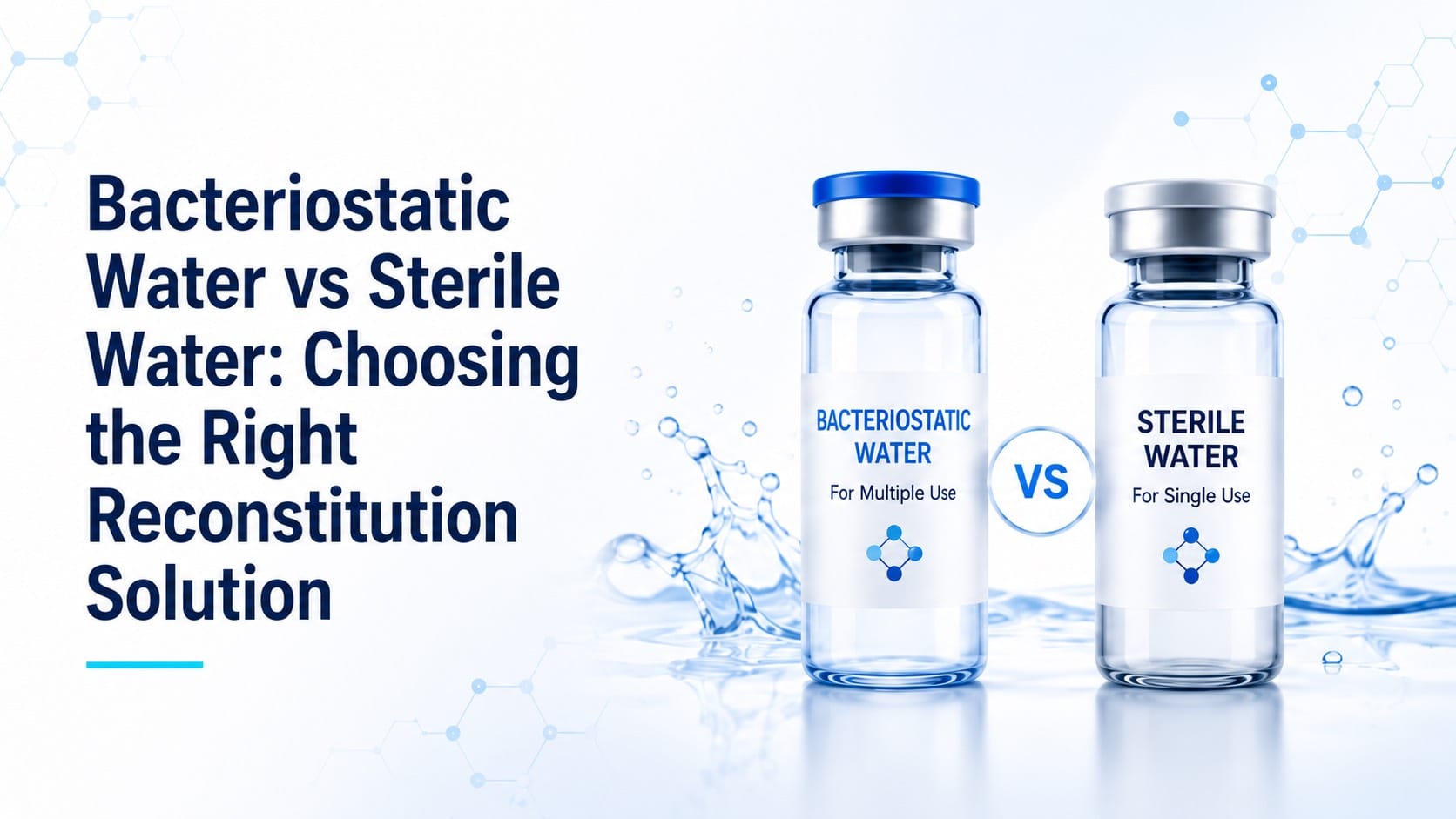
Sterile water contains no antimicrobial preservative. In laboratory work it may be selected where the method requires an unbuffered aqueous solvent and the preparation is controlled under an appropriate SOP. Its lack of preservative means the protocol must define microbiological controls and a justified hold time.
n
The word “sterile” describes the water product as supplied; it does not make the final peptide preparation sterile unless the complete process and final preparation have been appropriately controlled and tested.
n
Bacteriostatic Water
n
Bacteriostatic water typically contains benzyl alcohol as a preservative. That preservative may affect some assays, cell systems or analytical measurements, so compatibility must be established rather than assumed. It also does not guarantee that a prepared solution is sterile or stable for a fixed number of days.
n
Where bacteriostatic water is part of an approved research method, document the exact product, lot, preservative concentration and storage conditions.
n
Buffers and Specialist Solvent Systems
n
Some peptide methods require a defined pH, ionic strength or co-solvent. Buffers can improve solubility or stability, but they can also introduce assay interference or accelerate particular degradation pathways. Method development should examine recovery, specificity, precision and stability over the intended working period.
n
A Practical Compatibility Checklist
n
- n
- Does the published method identify the solvent, pH and concentration range?
- Is the peptide soluble and stable under those conditions?
- Could a preservative or buffer interfere with the assay?
- Are the container and closure compatible with the preparation?
- Are microbiological controls and hold time defined?
- Are blanks, reference materials and recovery checks included?
n
n
n
n
n
n
n
Concentration Is Arithmetic, Not a Protocol
n
Once a validated method defines the mass and total volume, concentration is calculated as mass divided by volume. Check this arithmetic independently; the calculation alone cannot determine solvent suitability, stability or the correct experimental design.
n
Storage and Documentation
n
Do not apply a blanket 14- or 28-day stability claim to every peptide solution. Stability depends on the specific compound and conditions. Record the batch code, diluent lot, nominal concentration, preparation date, operator, container, storage history and acceptance results.
n
For additional context, read the peptide storage guide and review the applicable batch-specific analytical report.
n
For research use only. Not for human or veterinary use.