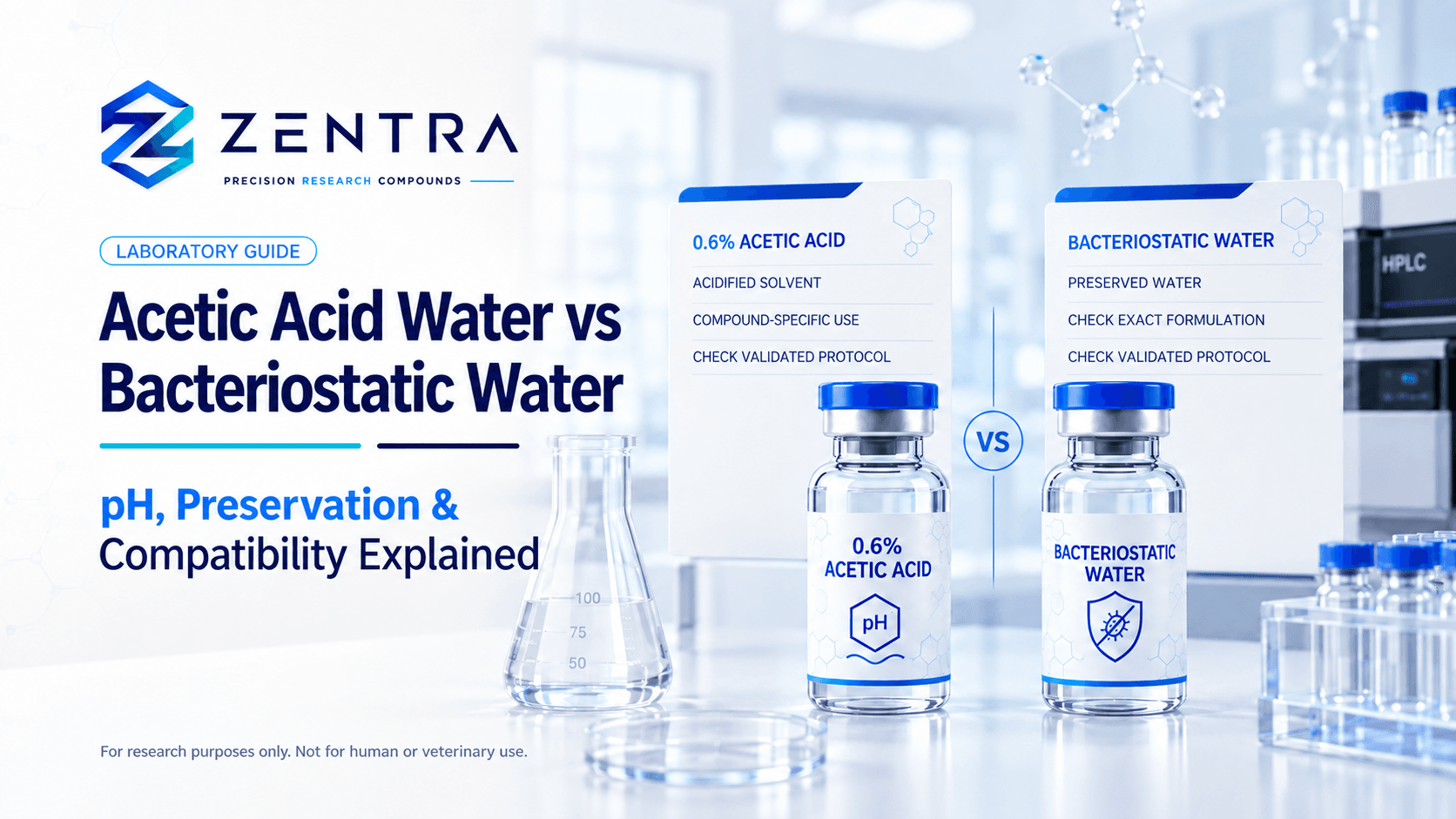
Acetic Acid Water vs Bacteriostatic Water: Laboratory Uses, pH and Compatibility
Research-use notice: This guide concerns laboratory solvent selection only. It is not a preparation guide for human or veterinary administration.
Short answer: Acetic acid water and bacteriostatic water are not interchangeable. Acetic acid water provides an acidic environment that may help solubilise certain research compounds. Bacteriostatic water is water containing a preservative—commonly 0.9% benzyl alcohol in labelled pharmaceutical products—rather than an acidifying agent. The correct choice depends on the compound, the validated method and the required pH and preservation conditions.
What is acetic acid water?
Acetic acid water is an aqueous solution containing a controlled amount of acetic acid. ZENTRA’s laboratory product contains sterile water with 0.6% acetic acid. Its purpose is to provide a mildly acidic solvent system for research compounds whose solubility is improved at lower pH.
It is not a universal solvent. Acidic conditions can be helpful for one compound and unsuitable for another, so researchers should follow a compound-specific, validated protocol.
What is bacteriostatic water?
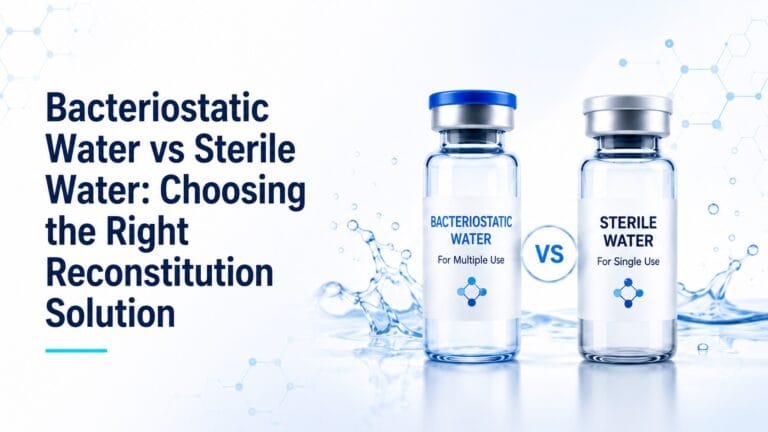
Bacteriostatic water is water formulated with an antimicrobial preservative. Official US labelling for Bacteriostatic Water for Injection describes 0.9% benzyl alcohol as the preservative and reports a pH range of 4.5 to 7.0. That reference describes the labelled product; researchers should always check the specification of the exact material they possess.
The word bacteriostatic refers to inhibition of bacterial growth. It does not mean the solution is self-sterilising, universally compatible or suitable for every experimental material.
What is the difference?
| Factor | Acetic acid water | Bacteriostatic water |
|---|---|---|
| Primary formulation role | Creates an acidic aqueous environment | Provides preserved water |
| Characteristic additive | Acetic acid | Usually benzyl alcohol in labelled products |
| Main selection question | Does the compound require acidic conditions for solubility? | Does the validated protocol call for preserved water? |
| Interchangeable? | No—composition and experimental purpose differ | |
| Research check | Confirm protocol, concentration, pH, clarity, stability and exact product specification | |
Why does pH affect laboratory compatibility?
The electrical charge and solubility of a molecule can change with pH. A research compound that is poorly soluble near neutral conditions may dissolve more readily in a mildly acidic environment. Conversely, an unnecessarily acidic environment may reduce stability or alter the behaviour of another material.
That is why visual clarity alone is not proof of chemical integrity. A clear solution may still contain a changed or degraded analyte, while temporary cloudiness may reflect a reversible solubility issue. Validated analytical methods—not appearance alone—should determine suitability.
How should a laboratory choose between them?
Start with the validated protocol
Use the solvent named in the experimental method, manufacturer documentation or peer-reviewed source. Do not substitute one water type for another simply because both look colourless.
Check the exact formulation
Record the additive, concentration, lot and expiry information. “Water” is not a complete specification when acidity or preservatives can influence the result.
Assess compound compatibility
Consider solubility, target pH, expected stability, container compatibility and downstream assay sensitivity. Preservatives or acidic conditions may interfere with certain analytical or biological methods.
Observe and document
Record clarity, colour, precipitation and any change over the validated observation period. Unexpected changes should trigger investigation, not an improvised correction.
Common laboratory mistakes
- Treating acetic acid water and bacteriostatic water as equivalent.
- Choosing a solvent from a generic online instruction rather than the compound-specific method.
- Assuming that “bacteriostatic” removes the need for controlled handling.
- Using a visible lack of particles as the only measure of stability.
- Failing to record the solvent formulation and batch in the experiment log.
Frequently asked questions
Is acetic acid water the same as bacteriostatic water?
No. The first is acidified with acetic acid; the second is defined by the presence of a bacteriostatic preservative. Their composition and experimental roles differ.
Why use an acidic solvent in research?
Some compounds have pH-dependent solubility. A controlled acidic environment may support dissolution when the validated protocol specifies it.
Does bacteriostatic water have a neutral pH?
Not necessarily. Official labelling should be checked for the exact product. One widely used labelled formulation reports a pH range of 4.5 to 7.0.
Can solvent choice affect an assay?
Yes. pH, preservatives and ionic conditions may affect solubility, stability, cells, enzymes or instrument response. Appropriate solvent controls are important.
Where can I find ZENTRA’s specification?
See the Acetic Acid Water laboratory product page for the current formulation and handling specification.